

Does the spoken word dominate your daily playlist? Do you log endless hours devouring podcasts of every stripe? If so, you’ve likely found yourself pondering the most elegant way to handle your everyday listening. Naturally, ruthless audiophile fidelity takes a back seat in this specific scenario, yielding pride of place to other priorities—spearheaded by sheer practicality, ergonomic comfort, and perhaps even the hygiene and fatigue concerns that come with marathon listening sessions. Having wrestled with this exact conundrum over the past few weeks, I figured it was high time to share my solution.
Set Aside Your Dedicated "Music" Cans
For casual everyday listening, I routinely reach for true wireless TWS IEMs alongside my other rigs. Yet for the ever-growing habit of listening to podcasts and spoken word in general, they’ve never quite hit the mark for me. More often than not, all I wanted was low-key background playback—not unlike my grandfather back in the day, who would prop a battered little transistor radio on a workbench while pottering about his workshop. In short, I needed earphones that practically vanished from conscious thought—ones that stayed just as effortless during minute one as they did at the tail end of a marathon, two-hour political debate. Crucially, passive acoustic isolation was the last thing I wanted; if anything, the opposite held true. My listening usually happens while winding down before bed, tackling household chores, or running errands at the local market, where keeping situational awareness is genuinely handy. Nor did I need a crowd-pleasing sound signature bursting with visceral sub-bass and shimmering, hyper-extended treble. Neither of those belongs in the natural human voice anyway.
Open-Fit Earbuds: An Oasis for Your Ear Canals
Then one day, a set of open-fit wireless earbuds crossed my desk—a form factor typically laughed out of the room by serious head-fi purists. Granted, they aren’t built for intense, eyes-closed critical listening sessions. But when paired with spoken word, their practical virtues won me over almost immediately. You can pop them in single-handed in a split second; their geometry never leaves you completely cut off from your surroundings; and there’s genuine relief in not jamming deep-insertion, ultra-isolating silicone wedges into your ear canals. It gives your ears a much-deserved break whenever uncompromised audiophile fidelity isn’t the primary goal. Because traditional earbuds don’t form a hermetic acoustic seal, they eliminate canal pressure build-up entirely, resulting in an experience that is remarkably natural and fatigue-free.

A Vastly Better Headset for Voice Calls
That loose, non-occluding fit brings along another massive advantage inherent to traditional earbuds. Have you ever tried holding a conversation—or taking an actual phone call—while wearing tight-sealing in-ear monitors? You know the ones: anchored deep inside your ears via silicone or foam tips. Your own speaking voice booms unnaturally inside your skull (the dreaded occlusion effect), and judging your own speaking volume becomes an awkward guessing game. Open earbuds are infinitely more civilized in this regard. You perceive your own voice almost completely naturally, making it effortless to gauge how loudly you're actually speaking.
Why Choose Open-Fit Wireless Earbuds?
- Virtually limitless all-day comfort, no matter how long the session runs
- Unrestricted freedom of movement (strenuous workouts notwithstanding)
- Minimal ear canal fatigue and physical strain
- Sleek, low-profile, and highly discreet aesthetics
- Lightning-fast insertion and removal
- Acoustic tuning naturally tailored for spoken word
- Retain complete situational awareness of your surroundings
- Zero occlusion effect—no unnatural booming when speaking
- Phone calls and voice chats feel vastly more organic than with sealed IEMs
The Earbuds I Refuse to Part With
It didn't take an exhaustive shootout to whittle the candidates down to the two models that now dominate my daily rotation. For a long time, the benchmark pick was the Apple AirPods; what they do, they simply execute better than the rest. Ergonomics are flawless, tonal balance is remarkably mature, and voice pickup on calls is top-tier. But strictly for podcasts and audiobooks, dropping that kind of coin can feel a touch excessive—or frankly, needlessly expensive. That prompted me to give the far more accessible Intezze EVO a proper spin.
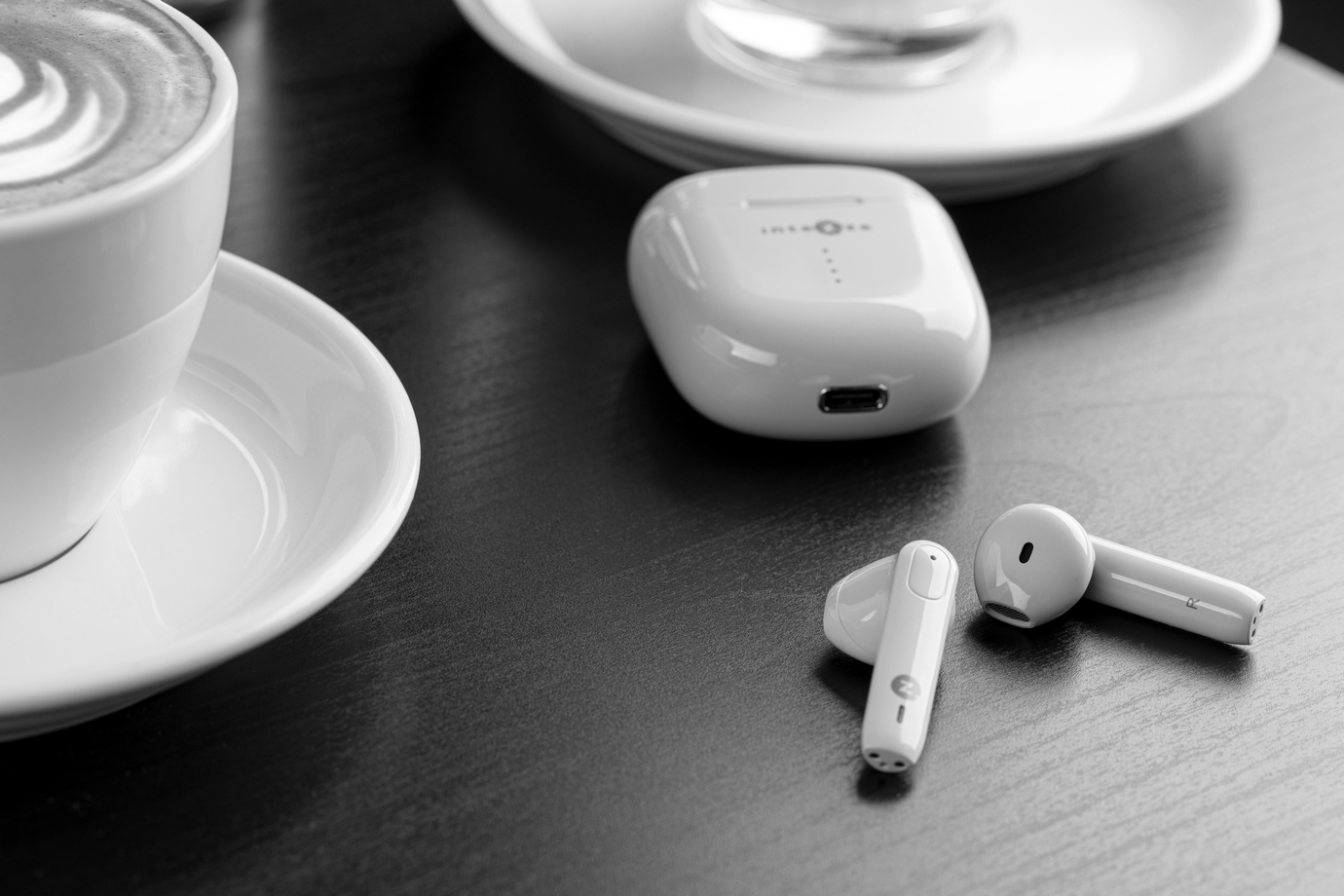
Cosmetically, the EVO clearly takes cues from the Cupertino blueprint, but coming in at just over 1,000 CZK (approx. €40 / $45), its value proposition easily outshines its illustrious rival. For vocal clarity and spoken dialogue, the presentation is spot-on, comfort is nothing short of absolute, and what it concedes to AirPods in microphone sophistication, it claws back with more tactile, forgiving touch controls. Nor is casual music playback a chore: for laid-back background listening in quiet surroundings, they punch surprisingly well above their weight.
When the Ambient Din Demands Real Isolation
That said, if your daily listening happens predominantly in noisy urban hustle—like rattling historic trams or bustling open-plan offices—the advantages of an open fit will work against you, forcing you toward designs offering firmer acoustic isolation. For solutions that retain some of the featherweight comfort of earbuds while relying on soft silicone tips for a passive seal, my first nod goes to the JAYS f-Five. They hit a sweet balance between ergonomic ease and vocal-centric tuning tailored for speech. An even comfier alternative might be our shop favorite, the Intezze CLIQ. It retains that universally friendly earbud-style chassis, while its acoustic voicing leans noticeably closer to full-bodied musical playback.

So consider giving your canals a breather when you aren't demanding summit-fi resolution from your gear. You might just discover that humble, open-fit earbuds have a permanent place in your everyday carry. Exactly like I did.


